
Class of 2025
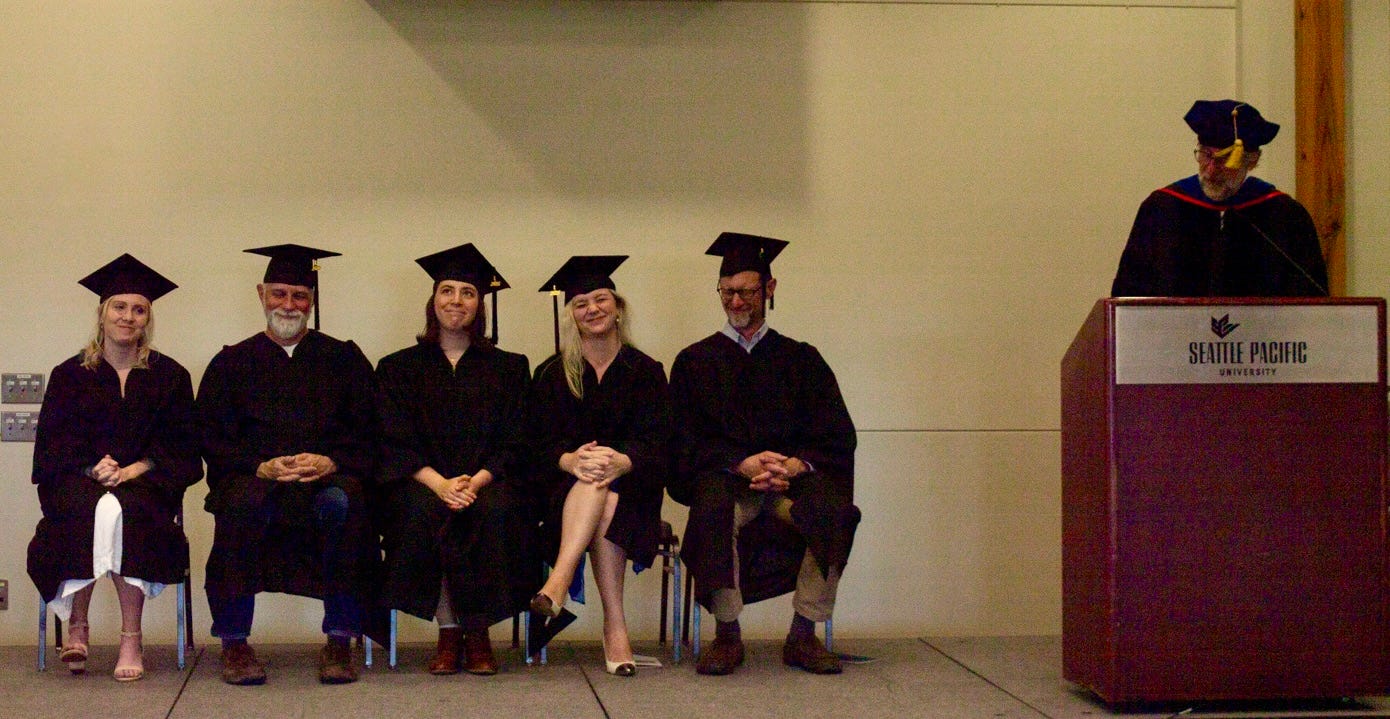
Last month I crossed a small stage at Seattle Pacific University to shake hands with Scott Cairns, receive a hood from Mischa Willet, and officially graduate with a Master of Fine Arts in Creative Writing. It is now time to (slightly) broaden the circle of friends I’m leaning on to help me continue to grow as a writer.
Excellent book recommendations were among the most treasured gifts from my time in the MFA program at Seattle Pacific University (now hosted by Whitworth University.)
It took a while to understand how to engage with a book primarily for the writing rather than the content. But spending hours with well-wrought words made it easier to shift my focus from what a work is what about to how it is about that.
I primarily read creative nonfiction, a category which is notoriously difficult to define. But I’ve learned those who love creative nonfiction relish work that is remarkably well written, an author relating events through personal experience, and using careful examination of something specific to effectively explore a universal aspect of the human experience. Three traits that are uncommonly common in the list that follows.
Why so much reading in a program on writing? I slowly learned and came to deeply appreciate a cue often repeated in lectures, conversations, and books about writing:
If you want to write more, read more.
If you want to write better, read better.
So read we did. Over two years, we each wrote sixty reaction papers on books, essays, and poems reflecting on the author’s voice, craft, and choices. Each student’s list of books was unique, depending on the mentor, student goals, style, and topics of interest. The sixty I chose are listed below. Each of these taught me something. Together they dramatically broadened my understanding of what writing can do in skilled hands.
Short List
My mentors David McGlynn and Robert Clark put together a list of CNF essentials for this program. From that list, I grappled with these:
James Agee / Knoxville: Summer of 1915
Wendell Berry / What Are People For?
Joan Didion / Slouching Towards Bethlehem
George Dyer / Out of Sheer Rage: Wrestling with D. H. Lawrence
Patricia Hampl / Blue Arabesque
Michel de Montaigne / Essays
Marilynne Robinson / When I Was a Child I Read Books
Richard Rodriguez / Hunger of Memory
Mary Ruefle / Madness, Rack, and Honey
W. G. Sebald / The Rings of Saturn
D. J. Waldie / Holyland: A Suburban Memoir
David Shields / Reality Hunger
Long List
They also provided a longer list of exceptional books. Although at this level, the distinction between first and second tier is like taking gold or silver at the Olympics.
John Berger / Here is Where We Meet
Frederick Buechner / Whistling in the Dark
Patricia Hampl / Virgin Time
Anne Lamott / Traveling Mercies: Some Thoughts on Faith
Kathleen Norris / Dakota: A Spiritual Geography
Walker Percy / Lost in the Cosmos
David Foster Wallace / Consider the Lobster
Christian Wiman / My Bright Abyss
Lauren Winner / Still
Art & Faith
Art & Faith lectures formed the conceptual center of this program. Each lecturer chose substantive and challenging texts to explore. Mercifully, the 90-minute, daily lectures during our residencies cracked open these literary geodes, enabling me to glimpse the gifts these works have for those with the skill to see.
Julian of Norwich / The Showings
T. S. Eliot / The Four Quartets
Emily Dickinson / 1461 from “Before The Door of God”
Christina Rossetti / Time Flies: A Reading Diary
William Shakespeare / King Lear
Emily Dickinson / The Complete Works of Emily Dickinson
Samuel Taylor Coleridge / The Major Works
Camille Dungy, ed. / Black Nature
Rachel Carson / The Sea Trilogy
Spiritual Experience
Many of my choices were guided by my abiding interest in how others experience the spiritual. Several of the books above do this well, but I selected the following titles primarily to see how others have described theses internal experiences of perceiving and relating to the Spirit.
St. Augustine / Confessions
Christian Wiman / Zero at the Bone
Stephen Pressfield / The War of Art
Simone Weil / Waiting for God
Brian Doyle / A Book of Uncommon Prayer
Sallie Tisdale / Mere Belief
Donald Miller / Blue Like Jazz
Burrows & Sweeney / Meister Eckhart’s Book of Darkness and Light
Craft
In addition to the craft books above, here are four more selected primarily to hear these authors reflect on the process and craft of writing.
Anne Lamott / Bird By Bird
Phillip Lopate / To Show and To Tell
Vivian Gornick / The Situation and the Story
George Saunders / A Swim in a Pond in the Rain
Humor
Evidently, very few people write well and with humor, but these are three of the best.
Harrison Scott Key / How to Stay Married
David McGlynn / One Day You’ll Thank Me
David Sedaris / Calypso
Fiction
One definition of Creative Nonfiction is “using the tools of fiction to write about true events.” To that end, Robert Clark consistently encouraged me to read more fiction, including these remarkable books: a novel, a short story, and a collection of stories.
William Maxwell / So Long, See You Tomorrow
Andres Dubus / A Father’s Story
Denis Johnson / Jesus’ Son
One of a Kind
The remaining titles were each selected for a different reason. But this unclassified list includes some of the heaviest hitters.
B. H. Fairchild / What He Said (a poem)
Esau McCauley / Reading While Black
Brian Doyle / One Long River of Song
Frederick Buechner / The Alphabet of Grace
Paul Kalanithi / When Breath Becomes Air
Richard Rodriguez / Late Victorians from “The Art of the Personal Essay”
Ross Gay / The Book of Delights
Ta-Nehisi Coates / The Message
Tim Bascom / Chameleon Days
C. S. Lewis / The Four Loves
Henry David Thoreau / Cape Cod
It’s impossible to quantify the benefits of reading and reflecting on these works, but there is no question their impact was substantial. On my first day in Seattle, the task of reading sixty books in twenty-four months loomed as a foreboding wall to be scaled. On the last day, it was clear they’d been a huge gift. Our readings were not the wall, but the ladder we used to ascend. How could I not pass them on?
What an incredible resource this is…saved for future reference. Congratulations as well!