
Haley’s thought-provoking post on 1 Kings 22 prompted me to appreciate the ways questions help us see more in scripture (Part 1) and invite us to think further (Part 2). But my initial impulses felt inadequate. A respectful response is going to require real work, joining Haley in engaging these enormous questions and offering an uncomfortably vulnerable and tenuous take on what I’m seeing.
By attempting this on Substack I have (oddly) chosen to keep the discussion out of the context of a traditional conversation, exchanging comments in real time. Which is likely why I find it challenging: I’m trying to retain the tentativeness of two people working through questions together, while using a format normally deployed to share conclusions.
In a personal conversation I can take much shorter turns, count on interruption when I’m headed off the tracks, ask questions to clarify, quickly and easily recant mistakes or rephrase where I just didn’t express something well. It’s private, forgiving, and ephemeral.
Public writing is different. It permits (and thus demands) more careful thinking, taking a longer turn, and I’m finding it seems to require moving toward some sense of resolution. A phone call would have been much quicker. And yet, the higher demands of writing are yielding benefits, pushing me to think further and providing an opportunity to shape an essay that holds less confidence than I am accustomed to reading.
I’m not done thinking but, as of today, this may be the best I can offer. A summary of my thinking thus far and a few conclusions I feel certain will change. All the usual caveats are in play: I have no formal training in theology, am still a learner who finds his own understanding revised regularly in ways large and small, and so on. But here are some thoughts which I hope will provide useful grist for Haley and anyone else wrestling with these questions.
Q1 - On a Good King Doing Stupid Things
Jehoshaphat, the ‘good guy’ king, does not say ‘inquire of the Lord’ immediately when Ahab propositions him for wartime allyship. Instead, the first thing he does is say something like ‘what’s mine is yours’ – a gesture at least as relational as it is political. The text does not easily offer an interpretation involving insincerity or manipulation. He subsequently goes to war with Ahab even after receiving the prophecy of failure from the prophet he himself pushed for, sensing the prolific falsehoods at hand. These are troubling, interesting, dense nuances
I must confess, my 2024 study of this chapter minimized the role of Jehoshaphat, seeing him primarily as a foil to Ahab’s refusal to seek guidance from the LORD. But now that Haley has pointed it out, I can see his missteps are glaring.
(By the way, Haley is undoubtedly familiar with the distinction between “Lord” and “LORD.” But I did not pick up on it right away. Once reminded that Lord means “any master” and LORD in all caps represents the name of the living God himself, the passage made more sense to me, so I’ve retained that style here.)
The first oddity she notes is Jehoshaphat making his offer of military support—“what’s mine is yours” —before encouraging Ahab to inquire of the LORD. That does suggest he’s privileging relationship over ethics.
I’m also struck by Jehoshaphat glibly riding his chariot into battle, agreeing to retain his regal dress while Ahab dons a disguise. Jeho does this knowing they are riding into a battle in which God has arranged to entice the king, the one wearing royal robes, to be killed. The scene goes all the way to slapstick when he turns to run, crying out as the enemy bears down on him.
Haley notes that Jehoshaphat is celebrated as a good king. An appraisal that will be repeated just a little lower on the page in verses 43-45. So which is it, good king or fool? Seems like both.
Nudged by Haley into a closer reading, I’ve noticed a tension approaching paradox in his desire to ally with Ahab. God is consistently in favor of reconciliation, restoration of relationships, and unity for his people. From this perspective, unifying the southern and northern tribes would be a glorious legacy for Jehoshaphat.
However, scripture is also consistent in warning against partnering with the wicked, whether that’s taking advice from a snake, filling a harem with foreign wives, or worshipping Baal alongside the one true God. Ahab is not a suitable ally since he is explicitly, the worst ever (1 Kings 16:30.)
Throughout scripture we see the story of a people who are loved and protected by God yet seem congenitally bound to reject his guidance. Israel fails repeatedly by trusting their own ideas over God’s, relying on military power rather than God’s protection, and making alliances with evil kings. (I’m speaking of Israel in the Bible here. Not commenting on current events.)
Perhaps this story highlights the potential for conflict between these two impulses: restoration and peace are good but pursuing them by partnering with the wicked leads to death.
Or, more generally, we can take Jehoshaphat as a warning that even those who sincerely trust in God are capable of being idiotic. A plan can be partially aligned with God’s values and still be foolish.
There is, no doubt, more to take from this story, but that’s how it’s landing for me right now.
Q3 - On Determinism and Freewill
Allow me to defer the second question for last, and take up this one next:
3 - How does God’s omniscience intersect with the many places he—in ‘real’ (human) time—changes His mind, as He does regarding Ahab’s fate in chapter 21? What does it mean that human action can prompt God to change? What are the implications, if any, of 1 Kings Ch 22 for determinism vs freedom RE human & divine will?
While I love many film genres, I find time travel plots difficult to enjoy. I have a cognitive allergy to the impossible logic and characters intent on changing futures that have already happened.

Discussions of omniscience trigger this same kind of reaction, frustrating my attempts to think it through. Does God know the future or cause it? If he causes it, I don’t see how we’re free or responsible for our actions. If he doesn’t cause it, how can he already know what will happen? And if he doesn’t know what will happen, how can we be confident things will work out as he promises?
Maybe he’s outside of time and can see it all at once. But if he can see the future, doesn’t that mean it’s already fixed in some sense? Perhaps it is because I live in time that this is beyond my comprehension. In my experience, decisions must be made and the future is uncertain. I don’t see a way to resolve this, and frankly I’ve grown weary of thinking about it.
Determinism and freewill seem to me straight up paradox: two claims that appear to contradict yet are both true. A friend helped me name this a few years back. I was wrestling with a puzzle along the lines of “who decided Ahab should go into battle?” He explained that both God’s sovereignty and our responsibility are present throughout the Bible. I was frustrated by looking for an either/or dichotomy, when the passage was clearly claiming both/and. Paying attention to this pattern for years now, I’ve seen it throughout the Bible. It might not be on every page, but it’s close to that.
There is much evidence of God knowing the future in detail, as if he is outside of time or equally close to all moments. And there are many stories of him interacting with people in real time, responding to what people do—like blessing Ahab when he repented.
For any meaningful relationship, it feels like we need some back-and-forth interaction. If God isn’t listening and responding, guiding and convicting, forgiving and teaching, then I’m not at all sure what’s on offer here. What are we called to if not the restoration of this kind of relationship?
Lately, I’m seeing the teachings of determinism and freewill as answers which meet distinct but complementary needs. When I’m asking whether my actions matter and if my life is meaningful, I’m drawn to passages providing assurance of freewill. When I’m asking if God’s promises will be kept, I look to the passages on determinism and omniscience. Together these answers give me the satisfaction of doing things that matter in my life, without the responsibility of keeping the entire world from going to hell. I need both perspectives to function with hope.
I’m not sure that will work for anyone else, but it’s giving me some peace these days as I continue making one decision after another, choosing to hope in the face of whatever will be in the headlines today.
Q2 - On God Giving Up
Of the three, this one seems the most tender, most vulnerable. It seems to hold the most fear, for self or others. It’s the one I’d least like to answer with a shrug.
2 - God seems to have given up on Ahab (Ahab was, after all, given many warnings and chances) – I’m not sure how else to register God’s seeming desire that he be enticed into a foolish and unnecessary death. Does God give up on people? Or is it just that His omniscience means He knows Ahab will never really come around, so what reads as ‘giving up’ is actually an acceptance of Ahab’s free (evil) choices, paired with perfect, divine understanding these will ultimately be ‘against’ Him?
The plainest reading is that yes, God has given up on Ahab, for the very reasons Haley articulates. I wonder how many were praying for the end of his violent tyranny, how many asking God why he allowed Ahab to live another day.
When Ahab repented, God responded immediately, and mercifully as described in chapter 21. But that was three years prior to the Jehoshaphat scene, and now he is back to his old ways of abusing power, killing to take whatever he wants, hating the LORD’s rule, and despising the last known prophet. If anyone needs to die, it’s Ahab.
And yet, even when I ask God to stop evil in the world, arranging a hit feels out of character. Death seems so wrong that I struggle to pencil in a line from ‘deception and murder’ to ‘goodness and love’. We wrestle with this, despite the Bible’s stories of divine judgement, and the promise of one more to come.
Attempts to connect good with death often assume that when someone is sufficiently wicked and powerful, death is not only the greatest good for the greatest number, it’s also the most merciful available option. I’m not saying I am qualified to judge, and Christ seems clear that I shouldn’t attempt it. But as a thought experiment, consider Hitler, Stalin, Mao, Hussein, Amin, or whichever cruel war-wager most offends you. Perhaps at some point, a man can be so far gone that even our exceedingly patient father agrees that death would be better for him than going on like this.
The idea of a mercy killing reminds me of cinema cowboys putting down a horse with a broken leg. When the rider knows the remainder of the horse’s life is all pain and suffering, no matter how much he loves this horse, the bullet is a kindness. If God knows there is no chance of repentance and restoration, I can see how it might be mercy to put him down.
The idea of letting go is stated more plainly in Romans 1:28-32
Furthermore, just as they did not think it worthwhile to retain the knowledge of God, so God gave them over to a depraved mind, so that they do what ought not to be done. They have become filled with every kind of wickedness, evil, greed and depravity. They are full of envy, murder, strife, deceit and malice. They are gossips, slanderers, God-haters, insolent, arrogant and boastful; they invent ways of doing evil; they disobey their parents; they have no understanding, no fidelity, no love, no mercy. Although they know God’s righteous decree that those who do such things deserve death, they not only continue to do these very things but also approve of those who practice them.
Here we have a strong assertion of freewill and responsibility. We know enough to do what is right. We don’t know it all, and we will make mistakes, but we have sufficient knowledge for moral culpability. Granted, in this passage God does not end life, but simply “gives them over” to the chosen state of mind. But it seems to give a direct answer to the question of whether God gives up.
As Haley mentions, if God knows the hearts of humans, then he knows when hope is gone. Examples include the flood survived only by Noah and his family and the meteoric fall of Sodom. He delayed the destruction of the Amalekites until their evil reached its fullness, but no longer. Something similar is happening today as he patiently waits for as many as possible to be saved before he brings this age to a close.
This fits well with the Bible’s near constant description of God’s outreach to us as an invitation which we are free to accept or reject. He seeks the love of his children, but love cannot be forced.
It seems that everywhere God has ended one or more lives, directly or through a mediator, it is clear that all hope has been lost. When all we do is kill, harm, and cause suffering; when no hope remains for redemption into real life, the contest is over. We’ve chosen death. There’s no point in prolonging the experiment. It sounds harsh, yet who would see mercy in leaving rotten fruit on the kitchen counter or a wounded horse in a ditch?
And yet.
Scripture doesn’t refer to humans as rotten fruit nor encourage abandoning the wounded. The prophet Isaiah speaks of God’s future servant, the savior, saying, “A bruised reed he will not break, and a smoldering wick he will not snuff out.”
Maybe God gives up on us in the same way a doctor gives up on a cadaver. At some point, there’s nothing left to do but record the time of death and prepare the grave.
Yet, I am immediately questioning my own analogy. In part because God defines life differently than medicine does. The kind of life Doctors work to save is rendered “bio” in Greek, defined by a pulse and respiration. God seems far more concerned with spiritual life, “zöe” in Greek. He is more interested in a heart that can still love and respond to love, than one that simply pumps blood. Perhaps Ahab was so committed to the rejection of all that is good, there was no hope left. At that point, the reed is not bent but broken. The wick is not smoldering, but cold. It’s over. Prepare a grave.
Perhaps this is why God was soliciting a volunteer from the heavenly host, “Who will entice Ahab into attacking Ramoth Gilead and going to his death there?” Maybe.
But even this feels off. Each characterization I choose seems to hide more than it shows, as if each attempt to bring resolution lops off important nuance and complexity.
Failing to find resolution often leads me into discussions. As I’ve talked to friends about this, they have reminded me of God’s patience which extends so far beyond my own. The “God of second chances” seems like a stingy name for what we see in scripture: a divine father, husband, brother, and lover who might better be called the “God of as many chances as it takes.”
In Tim Keller’s book, The Prodigal God, he reminds us that a “prodigal” is one who “spends in a recklessly extravagant way.” Yes, this fits the son who demanded his inheritance and rode off to spend it all on empty indulgence. But it also characterizes the father in this story, standing on edge of his estate, waiting for his lost son to return home. Presumably waiting for as long as it takes. Still hoping.
The pattern of patiently awaiting restoration is threaded throughout the Bible, starting on page two. Adam and Eve did not die on the spot. There was a real loss in being removed from the garden. They could no longer experience God’s direct presence. But they were given long lives in which to seek reunion.
In the second recorded wrong, a jealous Cain lifted a rock and smashed the skull of his brother. While a punishment of death might be just, God merely sent Cain away and promised him protection from vengeance, presumably leaving the door open for restoration.
For years, when asked how a good God could kill someone, I’ve cited a verse from Genesis 6 which tells us God chose to flood the earth when “the LORD saw that every inclination of the thoughts of the human heart was only evil all the time.” It’s time to put the horse down.
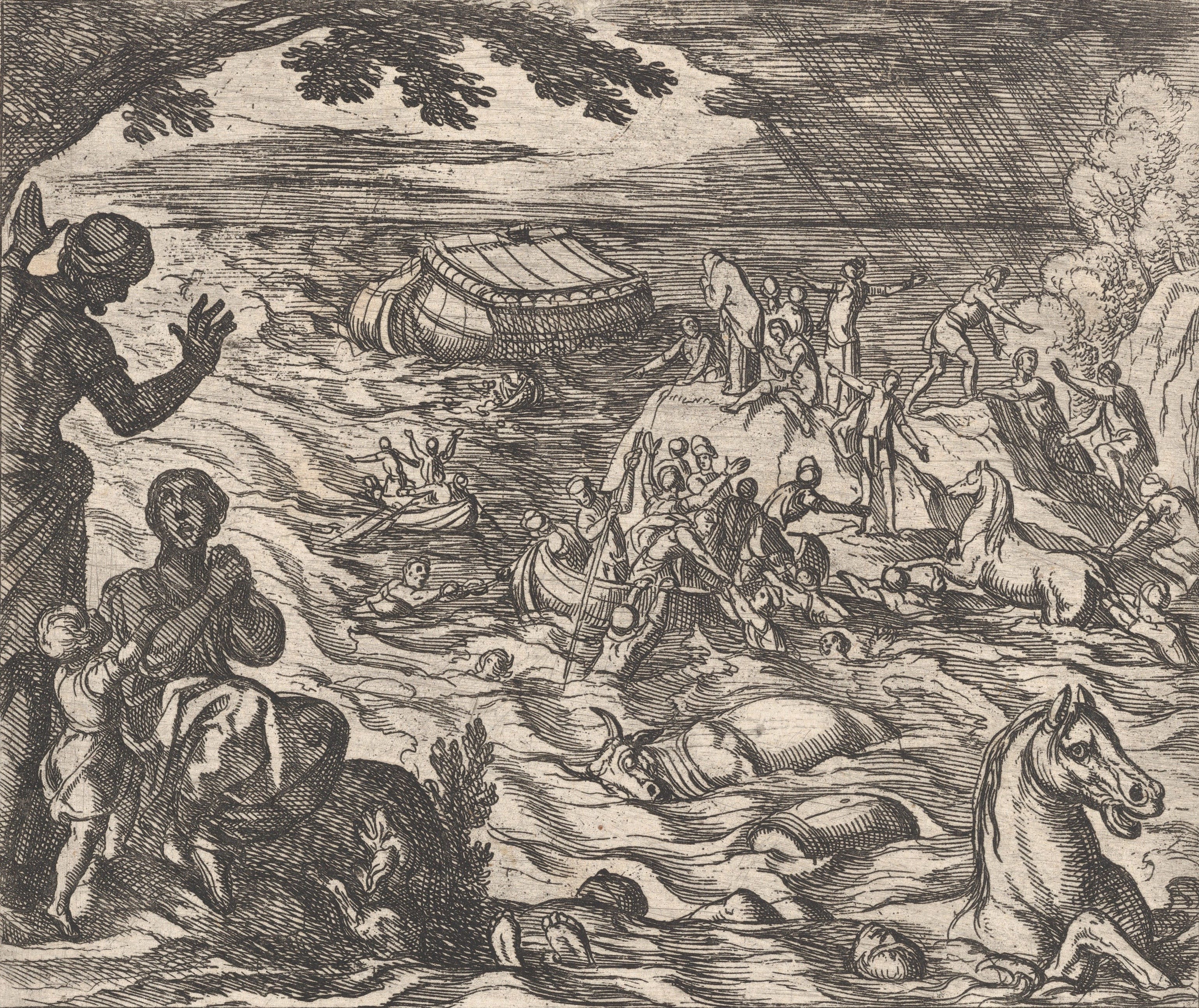
I was fairly settled into this argument when I read an extraordinary essay in Comment Magazine by Rhody Walker-Lenow.
Her exploration of the flood narrative, and reflection on what we typically leave out of our retelling, is affecting, instructive, and models deep thinking on scripture. Toward the end, she quotes that strange little passage [1 Peter 3:18-20.] which gives us the line in the Apostles Creed about Jesus descending into hell after the crucifixion. Peter tells us Christ was there to “make proclamation to the spirits in prison, who in former times did not obey, when God waited patiently in the days of Noah.”
Walker-Lenow notes this is the proper end of the flood story, when all the people who died in the flood are found. They were not obliterated but held in something analogous to a prison, life suspended in a place without freedom, awaiting their time before the judge. Peter tells us this was the first task of the Messiah, who “suffered for sins, once for all, the righteous and the unrighteous, in order to bring you to God.”
It seems God ended the heartbeats, the bios of these people when they had gone to only evil all the time. But even then, he preserved their hearts. Perhaps he ended their freedom primarily to protect them from doing further harm to themselves or others until the day of rescue and restoration.
I don’t know. But I don’t see a threat of giving up on us as essential to making a compelling invitation into life at its fullest. A threat seems a terrible way to build one’s capacity to return affection, to deepen trust, or to establish a relationship.
To anyone asking, “Has God given up on me?” the most appropriate response might be, “Do you want him to?”
The preponderance of evidence in scripture suggests to me that when the idea of ‘God letting go’ brings angst, we can trust he is still waiting, scanning the horizon, watching for my return.
Is this helpful in moving the conversation forward? It seems unlikely I’ve said anything Haley doesn’t already know. Come to think of it, making that the goal would put the bar well out of my reach.
Whether or not my thinking has been helpful for Haley, it should be clear how much her thinking has helped me. Haley’s questions pushed me to revisit and reconsider a story I thought I knew, learning much in the process. Her reading modeled techniques I’m finding helpful in exploring other passages. Her willingness to share questions led me to inspect my own understanding of God’s patience with the rebels, his perspective on the wandering, and the durability of his character, which grounds so much of my hope.
Dr. David McGlynn (on instagram) patiently mentored me for one year of the MFA program, consistently encouraging me to write about times of personal suffering. I continue to grow in my understanding of what he meant, expanding the definition of “suffering” to include “struggling with” or even “working through.”
Haley’s essay invites the reader into her mind and heart as she wrestles with God. And, looking back over my response, I can see I am trying to do the same. It is not possible for any of us to provide definitive, non-debatable answers to the questions Haley raised. But it does seem possible for me, or anyone else, to give some thought to these issues and share a little of our own struggle with them. Maybe Haley sees something in there that helps move her thinking forward. But even if she doesn’t, she knows she’s not alone in her meditations. And that may be reason enough to read. And write.
Acknowledgments—I learned a ton while working on this response, much of it from friends willing to entertain my thoughts in conversations or reviewing drafts along the way, including Mary Jane, Taylor, Billy, Ryan, Caiden, Rob, Shelly, John, and the inspired editorial attention of Rebecca. Gratitude seems insufficient recompense for your patience and guidance. I owe you.
Thank you for introducing me to Haley’s writing, and for taking the time to wrestle these wrestlings to the page. I love this kind of slow, Midrashic (I think I made up a new word) engagement with Scripture. It seems to be much more fruitful and faithful to the Spirit’s intent than our post-enlightenment dissections.
I’m so grateful for your, your deep-water heart, your high-heaven mind, David!