
Musing over a page from the Old Testament, my friend Haley Hodges has some questions [Haley’s essay]. And really, who wouldn’t? 1 Kings 22 recounts that time when God was searching for a strategy to entice the evil king Ahab to his much-deserved death in battle. The heavenly host gathered for a brainstorming session. Various proposals were floated and rejected until one spirit “finally” came up with a winner. He offered to mislead Ahab’s 400 prophets into delivering false promises of victory. God gave the thumbs up and off goes that spirit, carrying a lie leading a King to his death. What?!?
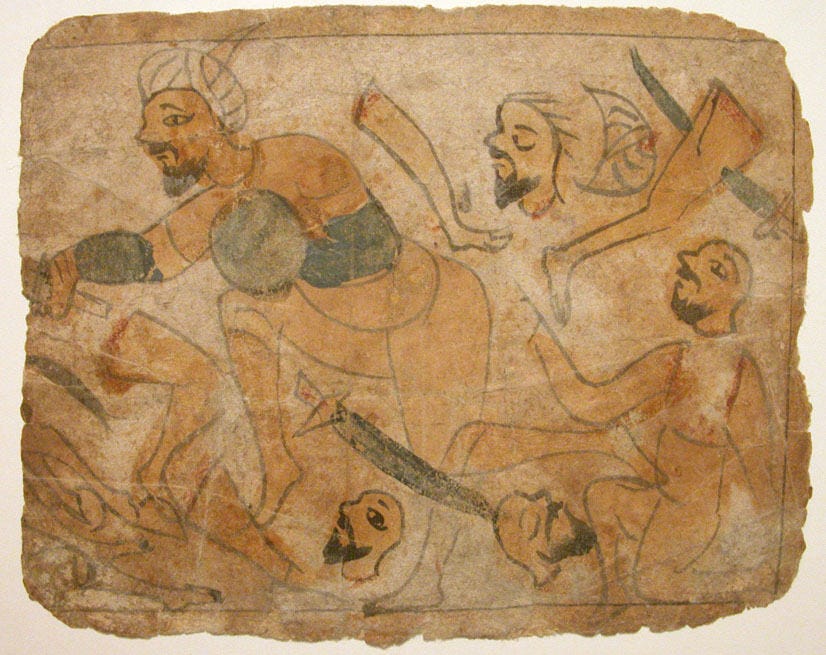
Haley writes about this as if peering over a steaming latte, still processing, eyes wide as she grapples with this “positively operatic” story:
Chapter 22 is one of those vivid passages replete with so much complexity and concurrent heavenly and earthly action that I lean back and think— ‘ok…is it just me, or is this some seriously wild shit??’
The candid blend of scholarly analysis and dramatic energy is an accurate but incomplete thumbnail of Haley. She is consistently exuberant and down-to-earth, in ways that can obscure her intellectual depth. During our two years in an MFA writing program (now hosted at Whitworth), her analysis was equally sharp whether scrutinizing rom-coms or transcendental poetry. This MFA is her third postgraduate program. The second was at Oxford, studying theology. She’s got range. To wit:
Ok. We’ve got God sitting up in heaven like some kind of mob-boss, hoping one of His (and this ambiguity interests me immensely) non-human servants—an angel?? or some kind of fallen-angel/demon better suited to dark dispensations?? – ‘entices’ Ahab to his death in battle. I’m just going to point out that this seems, you know, not very nice, even if we do understand it as a righteous judgment, which I think is certainly what the text wants of us.
Haley is an exceptionally perceptive reader. And, like so many poets, she writes with searing honesty. She wouldn’t lift her pen to repeat the obvious, nor is she here as an antagonist to challenge God’s goodness. She’s simply reading well, tackling legitimate questions raised by the text, and unafraid to let it show. (Shocking, I know.)
If Haley had floated her inquisitive reflections at the coffee shop just off campus, I would have responded as soon as she paused with her ever-expressive face demanding an answer. (This intense expectation is represented in her essay by the double question marks.) As a man old enough to be her father, and one who taught a study of 1 Kings just a few years back, I would likely have smugged out a utility phrase like, “If God looks bad, we know our reading is off.” This is a sincere and a useful perspective I employ with myself. But in this context, it comes off as dismissive, rebuffing the invitation to engage. As a friend, I owe her more.
By sharing her provocations publicly, she’s opened the door to a written response, raising the stakes for the conversation and pushing me to think more carefully.
Different Questions
The first thing I noticed is that she’s asks different questions than I did, resulting in a different reading. Questions work like headlamps, guiding our attention to reveal some things while leaving others in the dark.
See for yourself. Notice what stands out to you in the opening lines of this story:
For three years there was no war between Aram and Israel. But in the third year Jehoshaphat king of Judah went down to see the king of Israel. The king of Israel had said to his officials, “Don’t you know that Ramoth Gilead belongs to us and yet we are doing nothing to retake it from the king of Aram?” So he asked Jehoshaphat, “Will you go with me to fight against Ramoth Gilead?” Jehoshaphat replied to the king of Israel, “I am as you are, my people as your people, my horses as your horses.” But Jehoshaphat also said to the king of Israel, “First seek the counsel of the Lord.”
– 1 Kings 22:1-5 (NIV)
Compare what stood out to you with what caught Haley’s eye:
Jehoshaphat’s first response—before he does anything else—is to affirm his close relationship with Ahab: “I am as you are, my people as your people, my horses as your horses.” – only after broship confirmation—a purely relational move—does Jehoshaphat venture to say “Inquire first for the word of the Lord.”
Whatever you noticed, it probably wasn’t an exact match for Haley’s observations. I love this about scripture. It’s a big part of why I enjoy studying it in groups willing to discuss. We each see different things, which usually leads to intriguing conversations, and adds up to more than any one of us could have seen alone. This happens often enough for me to be persuaded these stories were crafted as conversation starters, among other things. It is one reason Tim Mackie of the Bible Project refers to the Hebrew scriptures as ancient Jewish meditation literature. The writing is provocative, intended to get us thinking whether alone or in conversation.
The questions we bring to a text are often shaped by our personal habits of mind. Through Haley’s experience in theatre as an actor, director, and teacher, she has honed her ability to rehydrate dialogue into characters. Each terse exchange she reads opens a window into a carefully constructed cosmos of motivations, relationships, and themes. The Biblical authors often wrote with great artistry, layered meanings, established patterns, call backs, and whatever else aided them in loading as much meaning as possible into each line. These techniques gave us very short stories that have kept people productively plumbing their depths for millennia. Literary techniques reward skilled readers, like Haley, who take the time to unpack them.
By contrast, my perspective is shaped more by my beloved commentaries. Written by scholars, these reference books offer concise overviews of historical context, translation issues, debates on interpretation, and how the passage relates to other scripture. Commentators synthesize centuries of scholarship to offer me the educational equivalent of fresh cut fruit on a platter: bite-sized and ready to eat. Commentaries allow me to become remarkably well informed with minimal time investment, which is a glorious gift when preparing a thirty-minute lecture every week. I truly love them, appreciate them, and am not giving them up.
Yet, I can also readily admit that the best learning is often slow-cooked. Scripture can be microwaved, but the flavors are better when simmered in a crockpot. Since the commentaries make it easy for me to quickly collect more than enough notes for a thirty-minute lecture, they can temper the urgency to dig for insights. There’s a temptation, at least for me, to lean too much on these books, treating them as the teacher’s edition for a passage, giving me all the answers with very little of the work.
When preparing a lecture, I often collect the most interesting facts, then look for a major theme or puzzling concept in the text to serve as my focus. Surveying related scripture helps me sketch a more systematic understanding of this big idea, which becomes my centerpiece. This is exactly how I approached my lecture on this passage a few years back.
While Haley begins by asking what motivates individual lines of dialogue, I open with contemplation of “providence” as a theological concept to explore. Haley looks closely at the first 39 verses of 1 Kings as they are given. I treat them as a mystery best solved by bouncing around to excerpts from more than a dozen books of the Bible. I’m extracting related passages from different authors, often writing centuries apart, to consider how phrases from different stories might bear on the big idea I’ve selected. I’m not saying this is wrong. I hope it’s not. I delight in the miraculous unity of scripture as a whole and plan to continue such explorations. But Haley’s read helps me see another way to productively engage the text and to realize my own approach seeks a coherence that is intentionally missing from 1 Kings 22.
Now I’m craving the Haley Hodges Dramatic Analysis Commentary Series. But even without all her answers and insights rendered in bite-sized chunks, her vector of questioning has already provided new tools for reading and reflecting.
Into the Fire
Shortly after reading Haley’s essay, I was preparing a lecture on Daniel 3—the story of Shadrach, Meshach, and Abednego. It opens with King Nebuchadnezzar erecting a golden obelisk to represent his empire. He summons a huge crowd to gather around the field where it towers. An announcer conveys the King’s command: when the music starts, you will adopt the posture of worship. This is a problem for the devout Jewish men at the center of the narrative. Captured in Israel and taken to Babylon, their exceptional talents have earned them positions of power and high visibility. But they refuse to bow to this symbol of conquering empire, which leads to their being bound with ropes and shoved into the furnace.
It’s been fifty years since I first heard this story on a Sunday morning. I have revisited it countless times since, as have most of the men in our group. The big idea was obvious: providence (again!) Commentaries helped on many key issues—what court astrologers did, the importance of publicly expressing fealty in melting pot cultures, that obelisks were built in antiquity with mortar requiring a large furnace at the build site, and so on. All helpful.
But Haley’s more theatrical read pushed me to stay in this story longer and look closer. I sought to empathize with individual characters. If I were cast as one of them in a play, how would I say their lines? If I were directing a film, how might I convey the felt experience of these few men, in a crowd of thousands, not bowing to the empire’s music?
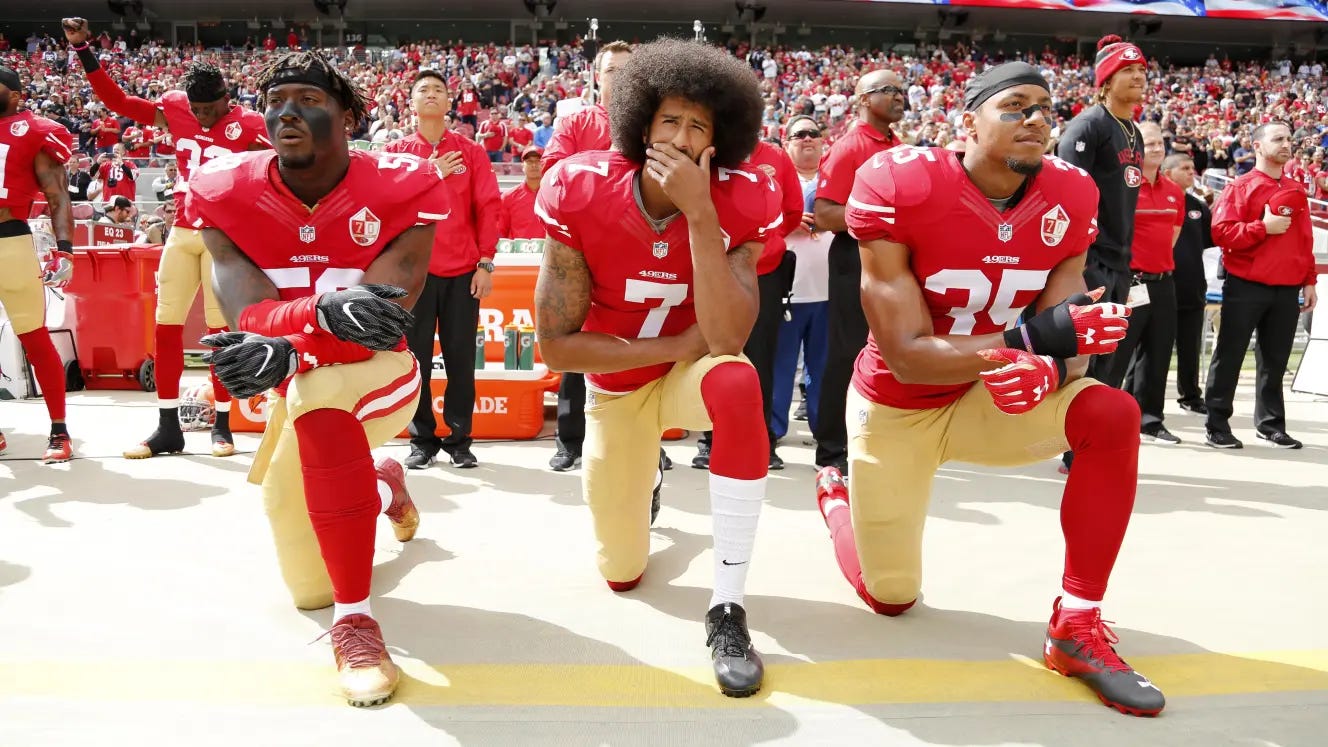
Just asking the question suggested the image of NFL players Colin Kaepernick, Eric Reid, and Eli Harold taking a knee during the national anthem. Remembering that moment helped me better feel the discomfort of conscientious objectors, silently but emphatically refusing to profess allegiance in a sea of easy conformance. This was the new insight I needed to see further into the passage, into the drama of the story, and thus better appreciate all it offered.
I am indebted to Haley for providing a new perspective, for reminding me of the way curiosity leads us into closer reading, and for demonstrating how multiple perspectives give us a more complete understanding.
Personally, I could stop here and be satisfied. But demonstrating how she reads was not Haley’s point. Her essay puts far more emphasis on the questions raised by the passage itself.
And that will require an essay of its own:
Questioning Scripture to Meditate (Part 2)